
Critical deadline if a road defect or municipal vehicle is involved: Pennsylvania law (42 Pa.C.S. § 5522(a)) requires that you give written notice of your claim to the responsible local government within 6 months of the accident — far shorter than the 2-year statute of limitations for the lawsuit itself. Missing this 6-month notice deadline can permanently bar your claim against the municipality, county, or PennDOT, even if you sue within 2 years. If a road design, traffic signal, missing signage, or pothole contributed to your crash, talk to a personal injury attorney immediately.
Lehigh Valley car accidents are among the most reported traffic incidents in eastern Pennsylvania, occurring with troubling regularity on specific corridors that drivers use every single day. Knowing which roads carry the highest risk – and understanding your legal options if a crash happens – can make a real difference in what comes next.
This guide focuses specifically on high-risk road segments in the Lehigh Valley, the patterns that cause collisions there, and what Pennsylvania drivers should know before and after an accident occurs.
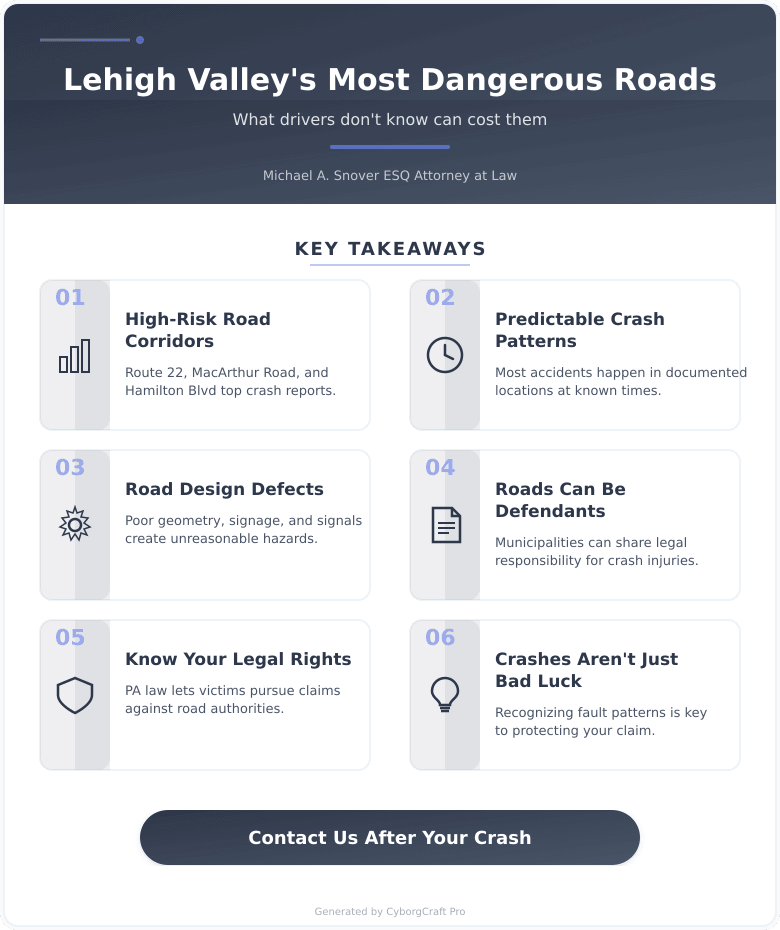
The most common mistake drivers make is assuming a crash was just bad luck. From what we see, a significant number of Lehigh Valley accidents happen in predictable locations, at predictable times, for reasons that are well-documented by traffic engineers and law enforcement. Route 22, MacArthur Road, and several intersections in Allentown and Bethlehem appear repeatedly in crash reports. That’s not a coincidence.
Lehigh Valley Roads With the Highest Accident Rates based on data from recent state crash reports
The Lehigh Valley sits at the crossroads of Routes 22, 78, and 309 – three of Pennsylvania’s busiest non-interstate corridors. According to the National Highway Traffic Safety Administration, congested multi-lane arterials like these account for a disproportionate share of serious injury crashes nationally, and local data mirrors that trend.
High-risk segments identified in recent crash data include:
- Route 22 between Whitehall and Easton – heavy commercial traffic and frequent lane changes create rear-end and sideswipe collisions
- MacArthur Road in Whitehall Township – a high-volume commercial corridor where access point density and turning movements contribute to frequent conflicts
- Route 309 near Quakertown – speed differentials between through traffic and turning vehicles cause T-bone crashes
- Hamilton Boulevard in Allentown – pedestrian crossings and signal timing contribute to intersection conflicts
- Airport Road near Lehigh Valley International Airport – a busy corridor where traffic volume and roadway conditions present ongoing safety challenges
- Schoenersville Road in Bethlehem – a local road where traffic volume and roadway conditions have been associated with collision activity
Secondary roads throughout the Lehigh Valley have seen increased traffic loads in recent years, including certain corridors in Bethlehem that were not originally designed for current demand. PennDOT continues to evaluate various corridors across the region for safety improvements, though the process takes time.
Want to explore your options after a crash on one of these roads? Contact us for a no-pressure conversation about what happened and what your rights are.
Why These Roads Produce So Many Crashes – The Real Reasons
Road design defect: A condition where a road’s geometry, signage, or traffic control creates unreasonable hazards for drivers exercising normal care.
Contributory negligence: A legal concept under Pennsylvania law where more than one party – including a road authority or municipality – may share responsibility for causing an accident.
Here’s what most drivers don’t realize: the road itself can be a contributing defendant. Pennsylvania law allows injury victims to pursue claims against municipalities and transportation departments when road design or maintenance failures contribute to a crash. That’s a meaningful legal avenue that gets overlooked constantly.
The pattern recognition here is clear. Accident clusters on MacArthur Road aren’t random – they track almost perfectly to specific driveways and poorly timed signals. On Route 22 eastbound near the Fullerton interchange, the issue is sightline geometry. Drivers can’t see stopped traffic in time to brake safely at posted speeds.
Rear-end collisions are among the most common crash types on multi-lane arterials in the Lehigh Valley, along with angle collisions at unsignalized intersections – both of which reflect patterns documented in statewide traffic safety research.
Knowing Your Rights After a Lehigh Valley Accident: A Comparison
Filing a Claim Yourself vs. Working With an Attorney
| Issue | Filing on Your Own | Working With an Attorney |
|---|---|---|
| Initial settlement offer | Usually the lowest figure the insurer thinks you will accept | Counsel benchmarks the offer against comparable PA verdicts and demands accordingly |
| Future medical costs | Often undervalued or omitted from your demand | Quantified with treating-physician opinions and life-care projections where appropriate |
| Liability disputes & comparative fault | Insurer’s adjuster controls the narrative | Counsel investigates, secures crash reconstruction, and protects you under PA’s modified comparative negligence rule |
| Municipal-defendant deadlines | High risk of missing the 6-month notice under 42 Pa.C.S. § 5522(a) | Notice is filed within statutory windows; preserves the claim against the municipality |
| Cost | No legal fees, but typically lower net recovery | Contingency fee (typically 33%–40%); no out-of-pocket cost unless you recover |
Where handling your own claim succeeds: Works reasonably well for minor property damage only, when liability is completely clear, and when your medical costs are minimal and already resolved.
Where handling your own claim fails: Insurance adjusters are trained to minimize payouts. Self-represented claimants consistently accept lower settlements. When injuries are involved, the gap is often substantial. Pennsylvania’s modified comparative negligence rules also create traps for unrepresented claimants who don’t understand how fault percentages affect recovery.
Where working with an attorney succeeds: Levels the playing field with insurers, ensures all damages are calculated correctly including future medical costs and lost wages, identifies third-party liability sources like municipalities, and protects you from recorded statement traps early in the process.
Where working with an attorney fails: Attorney fees are a real cost. For very minor claims, the math may not favor representation. And not every attorney handles accident cases the same way – local knowledge of Lehigh County courts and judges matters.
The verdict: For any accident involving injury, disputed liability, or commercial vehicles, professional legal guidance produces meaningfully better outcomes. For fender-benders with zero injuries, handling it directly with your insurer is usually fine.
| Scenario | DIY Claim | Attorney-Assisted | Best For |
|---|---|---|---|
| Minor property damage only | Viable | May not be cost-effective | Clear liability, no injuries |
| Injury involved | High risk | Strongly recommended | Any bodily harm |
| Disputed fault | Difficult | Essential | Multi-vehicle or intersection crashes |
| Commercial vehicle involved | Very high risk | Essential | Truck, fleet, or delivery vehicles |
| Municipality may be at fault | Near impossible | Required | Road defect or signage failures |
Thinking about this for your situation? Let’s talk. We’ll walk you through your options – no pressure. Reach out here and we’ll respond promptly.
Your Lehigh Valley Accident Action Plan
- Step 1 – Secure the scene: Move to safety if possible. Turn on hazards. Call 911 and request police even for minor crashes – a police report is critical for any future claim in Pennsylvania.
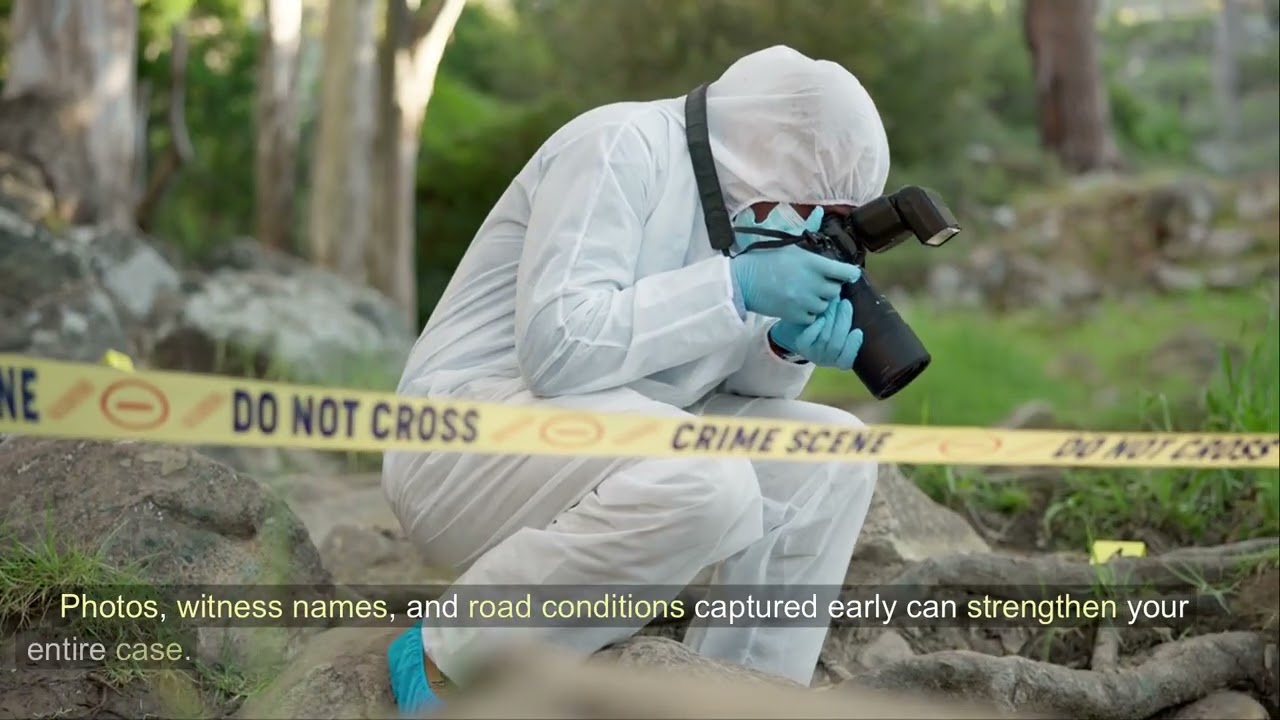
- Step 2 – Document everything immediately: Photograph vehicle positions, damage, road conditions, skid marks, traffic signals, and any visible injuries. Do this before vehicles are moved.
- Step 3 – Exchange information correctly: Get name, license number, insurance company and policy number, vehicle registration, and contact details for all drivers and witnesses.
- Step 4 – Seek medical attention the same day: Even if you feel fine. Adrenaline masks pain. Delayed treatment documentation is one of the most common ways insurers reduce injury payouts.
- Step 5 – Notify your insurance company: Report the accident promptly but do not give recorded statements to the other driver’s insurer without legal guidance.
- Step 6 – Understand Pennsylvania’s two-year statute of limitations: Personal injury claims in Pennsylvania must generally be filed within two years of the accident date. Missing this deadline eliminates your right to recover.
- Step 7 – Consult an attorney before accepting any settlement: Initial settlement offers arrive fast. They are almost never the best offer available.
At Michael A. Snover ESQ Attorney at Law, located in Bethlehem, PA, we work with clients throughout the Lehigh Valley – including Allentown, Easton, Whitehall, Bethlehem Township, Palmer Township, Lower Macungie, and surrounding Northampton and Lehigh County communities.
What Pennsylvania’s Insurance Rules Actually Mean for You
Pennsylvania operates as a choice no-fault state, which creates genuine confusion for drivers. When you register a vehicle here, you choose between limited tort and full tort coverage. That choice directly affects whether you can sue for pain and suffering after an accident – and most people don’t remember which one they selected.
Limited tort: Lower premiums but restricts your ability to recover pain and suffering damages unless injuries meet a serious injury threshold.
Full tort: Higher premiums but preserves your full right to sue regardless of injury severity.
According to the Pennsylvania Insurance Department, a significant portion of PA drivers are enrolled in limited tort coverage without fully understanding what they gave up. Checking your declaration page now – before an accident happens – is worth five minutes of your time. For a broader look at traffic safety data and road conditions, the National Highway Traffic Safety Administration publishes annual state-level crash statistics that provide useful context.
Frequently Asked Questions
Which roads in the Lehigh Valley cause the most car accidents?
Route 22, MacArthur Road in Whitehall, and Hamilton Boulevard in Allentown consistently appear in Lehigh Valley accident reports. Route 309 near Quakertown and Airport Road near Lehigh Valley International Airport also generate high crash volumes due to traffic volume and design limitations.
How long do I have to file a car accident claim in Pennsylvania?
Pennsylvania’s statute of limitations for personal injury claims is generally two years from the date of the accident. Missing this deadline typically bars you from recovering any compensation, so contacting an attorney early preserves your options.
What is the difference between limited tort and full tort in Pennsylvania?
Limited tort restricts your right to sue for pain and suffering unless you suffer a serious injury, while full tort preserves that right in all cases. Your choice affects your recovery options significantly and is determined by your auto insurance policy at the time of purchase.
Can I sue if a road defect contributed to my accident?
Yes – Pennsylvania law allows claims against municipalities or transportation agencies when road design, signage, or maintenance failures contribute to a crash. These claims involve specific procedural requirements and shorter notice deadlines, so prompt legal consultation is important.
What should I do if the other driver’s insurance contacts me after a Lehigh Valley crash?
You are not required to give a recorded statement to the other driver’s insurer, and doing so before understanding your claim can reduce your recovery. Speak with an attorney first to understand what information you’re obligated to share and how to protect your position.
How is fault determined in a multi-vehicle accident in Pennsylvania?
Pennsylvania uses a modified comparative negligence standard, meaning you can recover damages as long as you are less than 51% at fault for the accident. Your compensation is reduced by your percentage of fault, which is why accurate reconstruction and documentation of the scene matters enormously.
Key Takeaways for Lehigh Valley Drivers in 2026
- High-risk roads are predictable – Route 22, MacArthur Road, and Hamilton Boulevard appear repeatedly in crash data for structural reasons, not random chance
- Your tort selection matters – check your Pennsylvania auto policy now to understand what rights you retained
- Two-year deadline – Pennsylvania’s statute of limitations runs from the accident date and missing it ends your recovery options entirely
- Road authorities can share fault – municipal and PennDOT liability is a real legal avenue that many drivers never pursue
- Early documentation wins cases – photos, police reports, and same-day medical records form the foundation of any successful claim
Your Next Step After a Lehigh Valley Accident
If you’ve been in a crash on any of these roads – or anywhere else in the Lehigh Valley – the steps you take in the first 48 hours shape everything that follows. Insurance companies move fast. Adjusters are already working the case before you’ve finished dealing with your injuries.
Ready to get real answers about your situation? Contact us today for a straightforward conversation about what happened and what your options are. No obligation, no pressure – just honest guidance from people who know Lehigh County roads and Pennsylvania law. The sooner you get clear on where you stand, the better your position going forward.
For a complete overview of how we work with clients, visit our services page or return to the Michael A. Snover ESQ Attorney at Law homepage.
This content is for general informational purposes only and does not constitute legal advice. Reading this post does not create an attorney-client relationship. For advice specific to your situation, consult a licensed Pennsylvania attorney.