
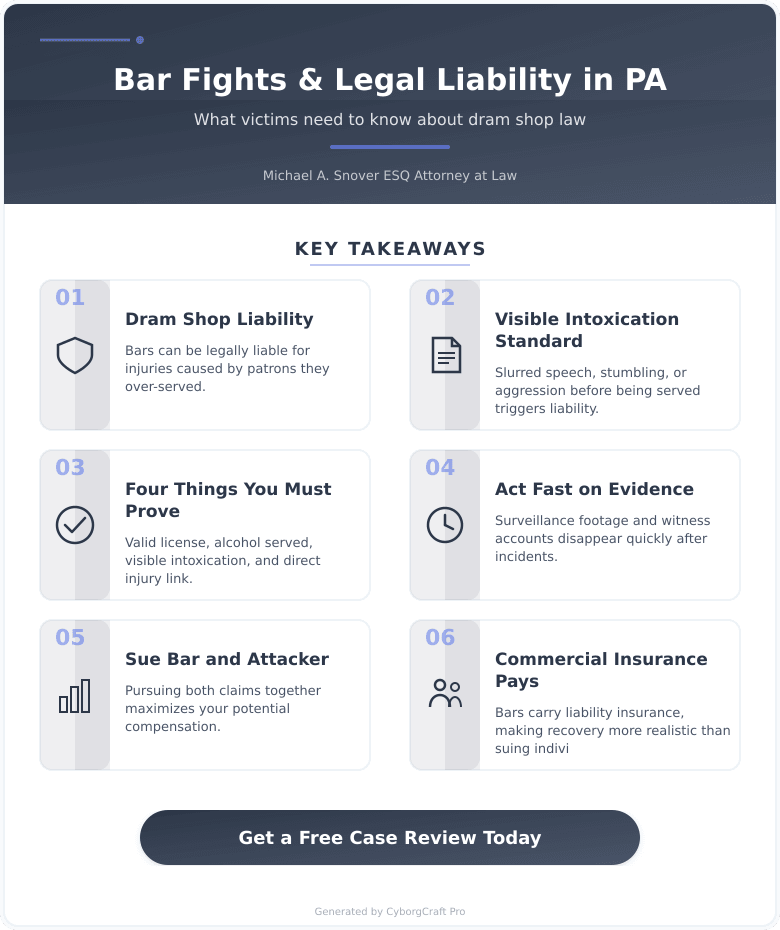
Dram shop liability is a legal doctrine that holds alcohol-serving establishments responsible for injuries caused by visibly intoxicated patrons they continued to serve. In Pennsylvania, this law gives innocent victims a direct path to compensation that most people never think to pursue.
Important on-premises vs. off-premises distinction: Pennsylvania’s dram shop statute (47 P.S. § 4-497) by its terms only reaches “damages inflicted upon [persons] off the licensed premises” by a visibly intoxicated patron the bar served. If the assault happened inside the bar, your claim against the establishment generally proceeds under premises liability and ordinary negligence theories — the bar’s duty to provide reasonably safe conditions, adequate security, and to intervene when a known threat develops — rather than the dram shop statute itself. The practical outcome can be similar, but the legal framework is different, and an attorney needs to plead it correctly.
The dram shop statute also reaches the licensee’s agents, servants, and employees who served the visibly intoxicated patron — not just the licensee personally. And note that a bar’s commercial general liability policy may contain an assault and battery exclusion that limits or eliminates coverage for fight-related claims, so identifying every available insurance policy early is critical.
This guide focuses specifically on innocent bystanders and victims of bar fights in Allentown and the Lehigh Valley who want to understand whether the bar itself shares legal responsibility for their injuries.
Dram Shop Liability Definition: A legal claim against a bar, restaurant, or licensed alcohol vendor that over-served a patron who then caused injury to another person, creating civil liability for the establishment under Pennsylvania’s Liquor Code.
Getting hurt in a bar fight you had nothing to do with is disorienting. One minute you’re at a table, the next you’re dealing with a broken nose, a concussion, or worse. Most people assume their only option is to sue the person who threw the punch. But here’s what changes everything: if that person was visibly drunk, and the bar kept serving them anyway, Pennsylvania law may hold the bar legally responsible too.
What Pennsylvania’s Dram Shop Law Actually Says
Pennsylvania’s dram shop statute falls under the Pennsylvania Liquor Code, specifically Section 4-497. Under current Pennsylvania law, a licensed establishment can face civil liability if it served alcohol to a visibly intoxicated person who then harmed someone else.
Visibly intoxicated means the patron showed obvious signs of being drunk – slurred speech, stumbling, aggressive behavior, or impaired coordination – before the bar served them another drink.
This is not a minor technicality. It’s a real legal claim that can produce meaningful compensation. And in Allentown, where bar fights happen in busy spots like Hamilton Street and downtown entertainment districts, these situations come up more than people realize.
According to general data from the Centers for Disease Control and Prevention, alcohol is a factor in roughly 40% of violent incidents. That connection matters enormously when you’re building a dram shop claim.
Proving the Bar Was Legally at Fault
Dram shop cases are not automatic wins. You have to show specific things happened. The most common mistake victims make is waiting too long to gather evidence – surveillance footage gets deleted, witnesses disappear, and bartender memories fade fast.
Here’s what actually needs to be established:
- The bar held a valid Pennsylvania liquor license at the time of the incident
- Staff served alcohol to the individual who harmed you
- That person showed visible signs of intoxication before being served
- The over-service directly contributed to the altercation and your injuries
The pattern we see repeatedly in these cases: bars in busy Allentown venues get overwhelmed on weekend nights, bartenders rush, and someone who should have been cut off gets two or three more drinks. That lapse in judgment is exactly what dram shop liability is designed to address.
Thinking about this for your situation? Let’s talk. Contact us and we’ll walk you through your options – no pressure, no obligation.
Suing the Attacker vs. Suing the Bar: Which Approach Works?
| Option | Potential Recovery | Practical Difficulty | Best For |
|---|---|---|---|
| Suing the Attacker | Varies widely | High – many attackers have no assets | Cases where attacker has documented income or assets |
| Dram Shop Claim Against Bar | Covered by commercial liability insurance | Moderate – requires evidence of over-service | Cases with clear over-service and documented injuries |
| Both Claims Together | Maximum recovery potential | Requires thorough investigation | Most serious injury cases |
Where suing the attacker alone succeeds: If the person who attacked you has assets, income, or insurance, a direct claim makes sense and can move quickly.
Where suing the attacker alone fails: Many people who start bar fights have limited financial resources. Even with a judgment, collecting on it is a separate and often frustrating battle.
Where a dram shop claim succeeds: Bars carry commercial general liability insurance. That insurance typically has real policy limits. This is often where actual compensation comes from in bar injury cases.
Where a dram shop claim faces challenges: You need evidence of visible intoxication before service. Bars rarely document this, which is why quick action matters.
The verdict: Pursue both claims simultaneously whenever possible. A good attorney investigates the bar’s liability from day one while also preserving claims against the attacker.
See how this approach applies to your situation – explore our services or reach out directly for a straight conversation about your case.
Your Bar Fight Injury Action Plan
- Step 1 – Get Medical Attention Immediately: Document every injury the same day. Medical records are the foundation of any personal injury claim, and gaps in treatment hurt your case.
- Step 2 – Report to Police: An official police report creates a formal record that the incident happened and identifies involved parties. Request a copy as soon as possible.
- Step 3 – Preserve Surveillance Evidence: Contact the bar in writing demanding they preserve all footage. Most commercial systems overwrite recordings within 30-72 hours.
- Step 4 – Collect Witness Information: Names, phone numbers, and brief accounts from anyone who saw the attacker’s behavior before and during the incident are valuable.
- Step 5 – Document Your Damages: Keep records of all medical bills, lost wages, and out-of-pocket costs related to your injuries.
- Step 6 – Contact an Attorney Before Talking to Insurers: Bar owners and their insurance carriers will investigate quickly. You should have representation before you speak with anyone from their side.
Pennsylvania’s Statute of Limitations – Don’t Miss This
In Pennsylvania, personal injury claims generally carry a two-year statute of limitations. That clock starts running on the date of the incident. Missing that deadline almost always means losing your right to any compensation, regardless of how strong your case is.
For dram shop claims specifically, gathering evidence fast is critical – not just because of the filing deadline, but because surveillance footage and witness recollections deteriorate quickly. Act sooner rather than later.
Key Takeaways for Allentown Injury Victims in 2026
- Pennsylvania dram shop law is real and enforceable – bars that over-serve visibly drunk patrons can be held civilly liable for resulting injuries
- You can pursue both the attacker and the bar – these claims are not mutually exclusive and together maximize your recovery potential
- Evidence disappears fast – surveillance footage, especially in downtown Allentown venues, is typically overwritten within days
- The two-year deadline is strict – waiting costs you options, even if your injuries seem manageable early on
- Insurance is often the real source of compensation – commercial liability coverage is why dram shop claims matter so much in practice
Frequently Asked Questions
What is dram shop liability in Pennsylvania?
Dram shop liability in Pennsylvania allows injury victims to sue bars or restaurants that over-served an intoxicated patron who later caused them harm. Under Section 4-497 of the Pennsylvania Liquor Code, visible intoxication at the time of service is the key standard for establishing liability.
Does Pennsylvania dram shop law cover bar fight injuries?
Yes, Pennsylvania dram shop law applies when a bar over-serves someone who then becomes violent and injures another person. If the bar knew or should have known the patron was visibly intoxicated and continued serving them, the establishment can face civil liability for your injuries.
How long do I have to file a dram shop claim in Pennsylvania?
Pennsylvania’s statute of limitations for personal injury claims, including dram shop cases, is generally two years from the date of injury. Missing this deadline typically bars any recovery, so early legal consultation is strongly advised.
What evidence do I need for a dram shop case?
Key evidence includes surveillance footage, witness statements about the attacker’s visible intoxication, bar receipts or tabs, police reports, and your medical records. Securing surveillance footage quickly is the most time-sensitive step because most systems overwrite recordings within days.
Can I sue both the bar and the person who attacked me?
Yes, Pennsylvania law allows you to pursue claims against both the attacker and the bar simultaneously. This approach typically produces the best financial outcome, since the attacker may have limited assets while the bar’s insurance policy is a more reliable source of compensation.
What communities near Allentown does this law apply to?
Pennsylvania dram shop law applies statewide, covering Allentown, Bethlehem, Easton, Emmaus, Whitehall, Northampton, and every other community in Lehigh and Northampton counties. The same rules apply whether the incident happened in a downtown bar or a neighborhood restaurant anywhere in the Lehigh Valley.
How much does a bar fight injury attorney cost?
Most personal injury attorneys, including those handling dram shop claims, work on a contingency fee basis – meaning no fees are owed unless you recover compensation. General industry practice typically involves a percentage of the final settlement or judgment, so upfront costs are rarely required for injured victims.
Your Next Step After a Bar Fight Injury
If you were hurt in a bar fight in Allentown or anywhere in the Lehigh Valley, the question of who pays your medical bills and lost wages shouldn’t be left to chance. Pennsylvania law gives you options most people don’t know exist. The bar that kept pouring drinks for someone who was clearly out of control may carry real financial responsibility for what happened to you.
Ready to get straight answers about your situation? Contact us today at Michael A. Snover ESQ Attorney at Law for a free consultation. Evidence fades fast, and 2026 case filings are active – don’t let the window close on your claim.