

Medical malpractice claims in Pennsylvania are civil lawsuits filed when a healthcare provider’s failure to meet the accepted standard of care directly causes a patient’s injury or death. Getting these claims right from day one can be the difference between receiving fair compensation and walking away with nothing.
This guide focuses specifically on clearing up the most damaging misconceptions Lehigh Valley residents carry into medical malpractice situations – and what Pennsylvania law actually requires.
Medical Malpractice Definition: Medical malpractice is a legal claim arising when a licensed healthcare professional deviates from the accepted standard of care in a way that directly causes measurable harm to a patient.
The most common mistake we see is that people assume a bad medical outcome automatically means malpractice occurred. That assumption leads them either to give up valid claims too early or to pursue claims that don’t meet Pennsylvania’s legal threshold. Both paths are costly.
Myth 1: A Bad Outcome Means Malpractice
Medicine involves risk. Surgeries fail. Treatments don’t work. Patients deteriorate despite excellent care. Pennsylvania law does not hold doctors liable simply because something went wrong.
To succeed in a medical malpractice claim in Pennsylvania, you must prove four specific elements:
- Duty: The provider owed you a professional duty of care.
- Breach: That duty was violated by falling below the accepted standard of care.
- Causation: The breach directly caused your injury – not the underlying condition.
- Damages: You suffered measurable harm as a result.
According to the U.S. Department of Health and Human Services, a significant portion of adverse medical events do not meet the legal threshold for malpractice. The injury must stem from negligence, not from the inherent risk of a procedure you consented to.
Standard of Care: The level of skill, care, and treatment that a reasonably competent healthcare provider with similar training would provide under the same circumstances.
Myth 2: You Have Plenty of Time to File
Note on the 7-year statute of repose: Pennsylvania’s MCARE Act once imposed a 7-year absolute deadline for medical malpractice claims, but the Pennsylvania Supreme Court struck that repose period down as unconstitutional in Yanakos v. UPMC (2019). The interplay between the discovery rule and the (now-invalid) repose period is complex — talk to a Pennsylvania attorney about how it applies to your situation.
This one destroys valid claims regularly. Pennsylvania imposes a two-year statute of limitations on most medical malpractice cases. The clock typically starts on the date you discovered – or reasonably should have discovered – the injury.
But there are layers here that trip people up:
- For minors, the two-year clock is tolled until the child’s 18th birthday — meaning most minors generally have until their 20th birthday to file (42 Pa.C.S. § 5533). Parents may file earlier on the child’s behalf, and doing so is strongly advisable to preserve evidence.
- The “discovery rule” can extend the deadline when an injury was not immediately obvious.
- Pennsylvania also has a “Certificate of Merit” requirement – a licensed professional must sign a statement confirming the claim has merit before your case moves forward.
- Missing either the filing deadline or the Certificate of Merit requirement typically results in automatic dismissal.
As of early 2026, Pennsylvania courts have shown little flexibility on these procedural requirements. Waiting too long is not a recoverable mistake.
Thinking about this for your situation? Let’s talk. Contact us for a straightforward conversation about where your case stands – no pressure, no obligation.
Going It Alone vs. Hiring Legal Representation: Which Approach Works?
Where self-representation succeeds: It can work for small claims court matters. It costs nothing upfront and keeps the person in full control of their case.
Where self-representation fails: Medical malpractice cases require professional witnesses, access to medical records, understanding of Pennsylvania’s Certificate of Merit rules, and the ability to depose healthcare professionals. Without legal training, most self-represented claimants lose before the case ever reaches trial.
Where legal representation succeeds: Attorneys who handle these cases know how to build causation arguments, identify the right medical professionals, and counter insurance defense tactics. Most work on contingency, meaning no fees unless you win.
Where legal representation fails: If a claim genuinely lacks merit, no representation will change the outcome. A good attorney will tell you that honestly upfront.
The verdict: For any medical malpractice claim in the Lehigh Valley, professional legal guidance is not optional if you want a real shot at compensation. The procedural and evidentiary requirements in Pennsylvania make solo navigation extremely risky.
| Approach | Typical Cost | Success Rate Context | Best For |
|---|---|---|---|
| Self-Representation | $0 upfront | Very low in complex cases | Minor disputes, not malpractice |
| Contingency Attorney | No fee unless you win (industry standard: 33%-40%) | Significantly higher with proper preparation | Medical malpractice and serious injury claims |
| Hourly Attorney | $250-$500/hr (2026 PA market range) | Depends on case strength | Consultation and case evaluation |
Myth 3: Every Doctor Is Personally Responsible for Everything
Patients often assume they can only sue the individual physician. Pennsylvania law is broader than that. Depending on the circumstances, liability can extend to:
- Hospitals and health systems (if a negligent employee acted within their job duties)
- Nursing facilities and urgent care centers
- Pharmacies that dispensed incorrect medications
- Anesthesiologists, nurses, and technicians involved in your care
Identifying all potentially liable parties matters because it affects what compensation is available. Recent shifts in how large health networks structure employment in 2026 have made this analysis more complex, not less.
Myth 4: The Settlement Offer Is Probably Fair
Insurance companies make early settlement offers for one reason: to close claims before claimants understand their full damages.
Pennsylvania law allows recovery for economic and non-economic damages in medical malpractice cases:
- Medical expenses (past and future)
- Lost income and reduced earning capacity
- Pain and suffering
- Loss of enjoyment of life
- In wrongful death cases, survivor benefits for family members
According to data from the Centers for Medicare and Medicaid Services, long-term care costs for serious medical injuries can run hundreds of thousands of dollars over a lifetime. An early offer rarely accounts for those future costs.
The pattern we see most consistently: people accept the first number they’re handed, then discover two years later that their ongoing care costs far exceeded that settlement. You cannot go back and reopen a settled claim.
See how legal guidance changes the conversation – explore our services to understand what full case evaluation looks like.
Myth 5: Medical Malpractice Claims Are Easy to Prove
Honestly, these are among the hardest personal injury cases to win in Pennsylvania. Beyond the two-year statute of limitations and the Certificate of Merit requirement, you also need a qualified medical professional willing to testify that the provider breached the standard of care.
Pennsylvania requires that the professional be in the same or similar specialty as the defendant. Finding the right professional, preparing them for deposition, and presenting their testimony convincingly takes real preparation.
The latest data from 2026 shows Pennsylvania’s malpractice defense bar is active and well-funded. Hospital systems carry substantial insurance with experienced defense attorneys on retainer. That’s the opposition a claimant faces without proper preparation.
Your Medical Malpractice Action Plan
- Step 1 – Document Everything Immediately: Request copies of all medical records, imaging, prescriptions, and discharge paperwork before memories fade or records are updated.
- Step 2 – Note the Timeline: Write down exactly when symptoms appeared, when you raised concerns with providers, and what responses you received.
- Step 3 – Consult an Attorney Early: Pennsylvania’s two-year deadline and Certificate of Merit requirement mean early evaluation protects your options.
- Step 4 – Avoid Social Media: Anything posted publicly can be used by defense teams to challenge the severity of your injuries.
- Step 5 – Do Not Sign Anything from Insurers: Any release signed before your attorney reviews it could permanently close your claim.
What to Gather Before Your Consultation
- ☐ All medical records related to the incident
- ☐ Insurance correspondence or settlement offers received
- ☐ A written timeline of events in your own words
- ☐ Documentation of financial losses (lost wages, out-of-pocket costs)
- ☐ Names and contact information of any witnesses
Key Takeaways for Lehigh Valley Residents in 2026
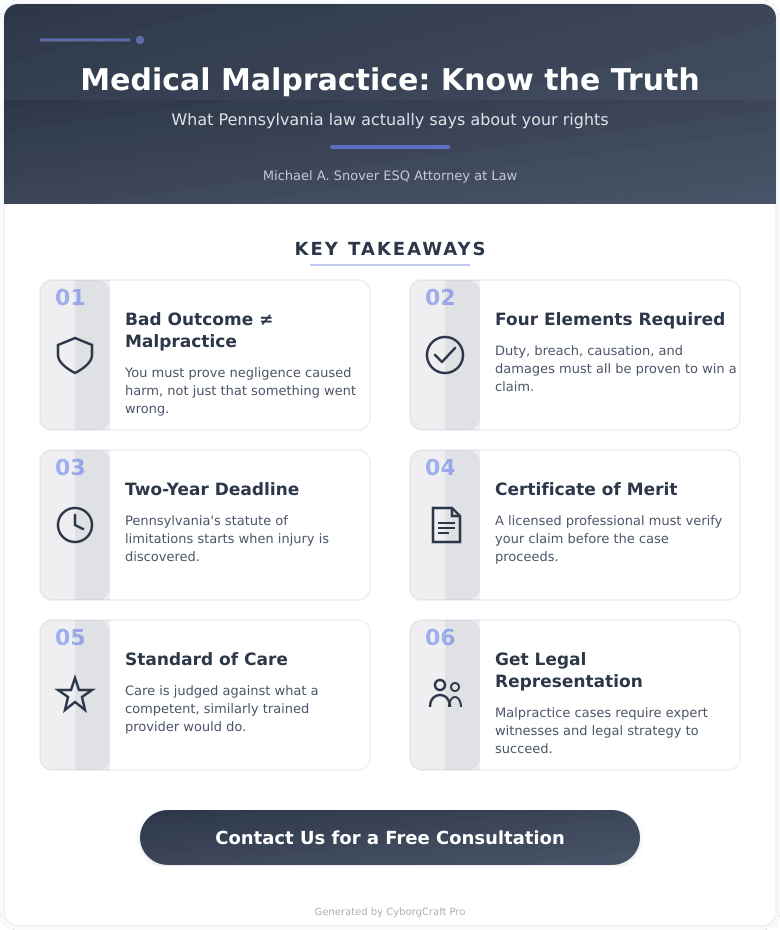
- Bad outcomes are not automatically malpractice – Pennsylvania requires proof of negligence and direct causation.
- The two-year statute of limitations is strict – Missing it ends your claim permanently in most situations.
- Multiple parties may carry liability – Hospitals, clinics, and support staff can all be responsible, not just the treating physician.
- First settlement offers are rarely fair – Future medical costs are rarely reflected in early insurance offers.
- Professional testimony is required – Pennsylvania mandates a Certificate of Merit from a qualified medical professional before your case moves forward.
Frequently Asked Questions
What is the statute of limitations for medical malpractice in Pennsylvania?
Pennsylvania gives most patients two years from the date they discovered – or should have discovered – the injury to file a medical malpractice claim. There are limited exceptions for minors and cases where injuries were not immediately apparent, but courts apply these rules strictly as of 2026.
Do I need a medical professional to file a malpractice claim in Pennsylvania?
Yes – Pennsylvania requires a Certificate of Merit signed by a licensed medical professional confirming that your claim has a reasonable basis before the case proceeds. Without it, the court will dismiss your case regardless of its underlying merit.
How much does a medical malpractice attorney cost in Pennsylvania?
Most medical malpractice attorneys in Pennsylvania work on a contingency fee basis, meaning you pay no fees unless you recover compensation. Industry standard contingency rates generally range from 33% to 40% of the final recovery, though terms vary by case and attorney.
Can I sue a hospital instead of just my doctor in Pennsylvania?
Yes – Pennsylvania law allows claims against hospitals, health systems, and other institutional providers when their employees or agents caused harm through negligence. Identifying all liable parties is a critical part of building a complete claim.
What damages can I recover in a Pennsylvania medical malpractice case?
Pennsylvania allows recovery for medical expenses, lost income, pain and suffering, and loss of enjoyment of life. Wrongful death claims may also provide compensation for surviving family members. Future costs are a key component that early settlement offers often ignore.
How long does a medical malpractice case take in Pennsylvania?
Most medical malpractice cases in Pennsylvania take two to four years from filing to resolution, though cases that settle before trial can resolve faster. The timeline depends heavily on the complexity of the medical issues, the number of defendants, and court scheduling in the Lehigh Valley area.
What This Means for You Right Now
If something went wrong with your medical care in the Lehigh Valley – in Allentown, Bethlehem, Easton, Nazareth, or anywhere in Northampton or Lehigh County – the window to act is real and it is limited. Pennsylvania’s rules are not forgiving of delays.
At Michael A. Snover ESQ Attorney at Law, located in Bethlehem, PA, we work with residents throughout the Lehigh Valley to evaluate medical malpractice situations clearly and honestly. If a claim has merit, we’ll tell you. If it doesn’t meet the legal threshold, we’ll tell you that too.
Ready to get straight answers about your situation? Contact us today for a free consultation. The two-year clock in Pennsylvania does not pause, and understanding where you stand costs nothing.
Disclaimer: This content is provided for general informational purposes only and does not constitute legal advice. Reading this post does not create an attorney-client relationship. For guidance specific to your situation, please consult a licensed Pennsylvania attorney.