

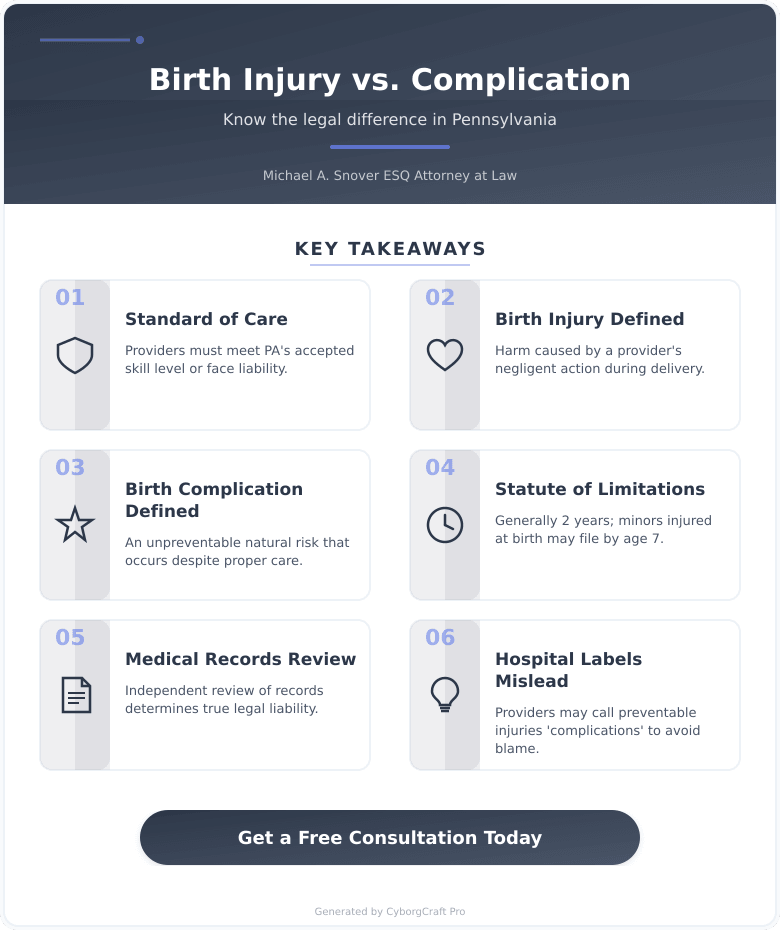
Birth injuries vs. birth complications is a legal distinction that determines whether a family has grounds for a medical malpractice claim in Pennsylvania. Understanding the difference is the first step any Lehigh Valley parent should take after a traumatic delivery experience.
This guide focuses specifically on Pennsylvania parents in the Lehigh Valley who want to understand whether a difficult birth outcome may carry legal weight.
Definition: A birth injury is harm caused by a medical provider’s negligent action or failure to act during pregnancy, labor, or delivery. A birth complication is an unexpected medical event that occurs without negligence – a natural risk of childbirth that no amount of reasonable care could have prevented.
The most common mistake families make is assuming these two things are the same. They are not. One may give your family legal standing to pursue compensation. The other, as painful as it is, typically does not. The question is always: did a healthcare provider deviate from the accepted standard of care?
What Separates a Birth Injury from a Birth Complication?
Doctors, nurses, and hospital staff are held to what Pennsylvania law calls the “standard of care” – the level of skill and treatment a reasonably competent provider would deliver in the same situation. When they fall below that standard and a child or mother is harmed, that is a birth injury in the legal sense.
Birth complication: A medically recognized risk that can occur despite proper care – such as a true umbilical cord prolapse with no delayed response, or a rare placental abruption caught and treated promptly.
Birth injury: Harm that results from a provider’s error – such as delayed response to fetal distress signals, improper use of forceps or vacuum extraction, or failure to order a timely C-section when one was clearly warranted.
According to the Centers for Disease Control and Prevention, birth trauma affects approximately 7 in every 1,000 live births in the United States. Not all of those are the result of negligence – but many are, and families deserve to know the difference.
Birth Injury vs. Birth Complication: Which Approach Works?
Where a birth complication claim succeeds: When medical records show the provider responded appropriately, followed established protocols, and the outcome was genuinely unpreventable given the clinical circumstances.
Where a birth complication claim fails: When providers retroactively label a preventable injury as a “complication” to shield liability – a pattern families and their attorneys must watch for carefully.
Where a birth injury claim succeeds: When medical records, fetal monitoring strips, and professional review show a clear deviation from standard care – delayed C-section, misuse of delivery tools, or failure to respond to distress signals.
Where a birth injury claim fails: When the harm truly resulted from a known, unpreventable risk that was disclosed and managed appropriately, or when the statute of limitations has passed.
The verdict: The label a hospital places on a birth outcome does not determine legal liability. An independent medical and legal review of your records does. Families should never accept a hospital’s characterization without getting an outside opinion.
| Factor | Birth Complication | Birth Injury |
|---|---|---|
| Cause | Natural, unpreventable risk | Provider error or negligence |
| Legal standing | Generally none | Potential malpractice claim |
| PA statute of limitations | N/A | Generally 2 years from discovery or injury; minors injured at birth: the clock is tolled until the child’s 18th birthday under 42 Pa.C.S. § 5533, so they generally have until their 20th birthday to file |
| Key evidence | Medical records showing proper care | Deviation from standard of care |
| Professional review needed | Confirms no negligence | Confirms negligence occurred |
Thinking about your own situation after a difficult delivery? Let’s talk. Contact us for a free consultation – no pressure, no obligation.
Common Birth Injuries That May Carry Legal Weight in Pennsylvania
- Cerebral palsy caused by oxygen deprivation during delivery
- Brachial plexus injuries (Erb’s palsy) from excessive traction
- Hypoxic-ischemic encephalopathy (HIE) from delayed C-section decisions
- Skull fractures or brain bleeds from improper forceps or vacuum use
- Shoulder dystocia injuries mishandled during delivery
- Maternal injuries from failure to monitor or treat complications promptly
The American College of Obstetricians and Gynecologists maintains clear clinical guidelines for these scenarios. When providers ignore those guidelines, legal accountability becomes possible.
Pennsylvania’s Statute of Limitations: Do Not Wait
Note on the 7-year statute of repose: Pennsylvania’s MCARE Act formerly imposed a 7-year absolute deadline for medical malpractice claims, but the Pennsylvania Supreme Court struck that repose period down as unconstitutional in Yanakos v. UPMC (2019). Any older guidance referencing a 7-year cutoff is no longer reliable.
Pennsylvania’s statute of limitations for medical malpractice is generally 2 years from the date of discovery (42 Pa.C.S. § 5524). For minors, that clock is tolled until the child’s 18th birthday under 42 Pa.C.S. § 5533 — meaning the child generally has until their 20th birthday to file. Parents may (and usually should) file earlier on the child’s behalf to preserve evidence and witness testimony., with certificate of merit required. For minors injured at birth, Pennsylvania tolls the statute of limitations until the child turns 18 under 42 Pa.C.S. § 5533, giving the child 2 years from their 18th birthday — until their 20th birthday — to file. Parents may pursue the claim earlier on the child’s behalf, and should not wait.C.S. § 5533).
This sounds like a long window. It is not. Medical records get harder to obtain over time. Professional witnesses build schedules years out. And the earlier a legal review begins, the clearer the picture of what happened in that delivery room.
Recent data shows that families who delay legal review by more than 12 months face significantly more difficulty reconstructing the chain of clinical decisions made during delivery. Start the process as early as you can.
Your Birth Injury Legal Action Plan
- Step 1 – Gather your medical records: Request complete delivery records, fetal monitoring strips, nursing notes, and physician orders. These are the foundation of any legal review.
- Step 2 – Document everything you experienced: Write down your recollections now – what you were told, what felt rushed, what changed suddenly. Memory fades and documentation matters.
- Step 3 – Request an independent medical review: A qualified attorney will work with medical professionals to assess whether the standard of care was met. This step determines whether you have a viable claim.
- Step 4 – Understand the damages available: Pennsylvania allows recovery for medical expenses, ongoing care costs, lost future earning capacity for the child, and pain and suffering.
- Step 5 – File before the deadline: Confirm the applicable statute of limitations for your specific situation with a Pennsylvania attorney as early as possible.
What to Gather Before a Legal Consultation
- ☐ Complete hospital delivery records
- ☐ Fetal heart rate monitoring strips (if obtainable)
- ☐ Prenatal visit records and test results
- ☐ Discharge summary and any NICU records
- ☐ Written account of your personal delivery experience
- ☐ Insurance and billing records from the delivery
Key Takeaways for Lehigh Valley Parents in 2026
- The legal distinction matters – a birth injury involves negligence; a complication does not, and one supports a malpractice claim while the other typically does not
- Hospitals do not always label outcomes correctly – an independent legal and medical review is the only reliable way to know what happened
- Pennsylvania’s deadlines for minors depend on the specific circumstances – but earlier action is always better for evidence preservation
- Professional medical review is required – Pennsylvania law requires a certificate of merit from a medical professional before a malpractice case proceeds
- Free consultations are available – you do not need money upfront to find out whether you have a case
Frequently Asked Questions
What is the legal definition of a birth injury in Pennsylvania?
A birth injury in Pennsylvania is harm to a newborn or mother caused by a healthcare provider’s failure to meet the accepted standard of care during pregnancy, labor, or delivery. This is distinct from a birth complication, which is an unpreventable medical event. Pennsylvania requires professional medical review to establish this distinction in court.
How do I know if my child’s condition was caused by negligence?
You cannot know for certain without an independent review of your medical records by a qualified medical and legal team. Conditions like cerebral palsy, Erb’s palsy, or HIE may result from negligence, but determining that requires examining fetal monitoring data, delivery notes, and physician decisions in detail.
How long do I have to file a birth injury claim in Pennsylvania?
Pennsylvania generally allows two years from the date of injury or discovery for adults, and For minors injured at birth, the statute of limitations is tolled until the child turns 18, so the child generally has until their 20th birthday to file under 42 Pa.C.S. § 5533. Parents may pursue the claim on the child’s behalf earlier and should not wait — evidence and witness memory degrade quickly. These deadlines have exceptions and nuances that a Pennsylvania attorney can clarify for your specific situation.
How much does a birth injury case cost to pursue?
Most birth injury attorneys handle these cases on a contingency fee basis, meaning you pay no upfront legal fees. The attorney’s fee is a percentage of any settlement or verdict. If there is no recovery, you typically owe no legal fee. Nationally, contingency rates in medical malpractice cases commonly range from 33% to 40%.
What damages can Pennsylvania families recover in a birth injury case?
Pennsylvania families may seek compensation for past and future medical expenses, long-term care and therapy costs, the child’s loss of future earning capacity, and pain and suffering. Damages in serious birth injury cases can be substantial, reflecting a lifetime of care needs.
Does Pennsylvania require a certificate of merit to file a birth injury lawsuit?
Yes. Pennsylvania law requires a certificate of merit signed by a qualified medical professional stating that the provider’s care fell below the standard before a malpractice case moves forward. This requirement is one reason working with an experienced legal team early is important.
Can I still pursue a claim if the hospital said it was just a complication?
Yes. A hospital’s internal characterization of a birth outcome does not legally determine whether negligence occurred. Independent medical review frequently uncovers evidence that contradicts how a hospital documented a delivery.
Your Next Step Starts Here
If your child or family member was harmed during delivery at St. Luke’s, Lehigh Valley Health Network, or any other Bethlehem, Allentown, or Easton area hospital, you deserve honest answers – not medical jargon designed to protect an institution.
At Michael A. Snover ESQ Attorney at Law, based in Bethlehem, PA, we believe every Lehigh Valley family deserves a clear-eyed assessment of what happened during their delivery – without pressure and without cost upfront.
Ready to take the next step? Contact us today for a free consultation. The most important thing you can do right now is get an independent review of your records before more time passes. For a full overview of how we can help, visit our services page.
This content is for informational purposes only and does not constitute legal advice. Consult a qualified Pennsylvania attorney regarding your specific situation.