
Pennsylvania motorcycle accident settlements are evaluated under a distinct legal framework that differs significantly from standard car crash claims. Because motorcyclists face unique statutory rules, insurance barriers, and bias challenges, the outcome of your claim depends heavily on understanding how those differences work against you from day one.

This guide focuses specifically on how Pennsylvania’s fault system, insurance rules, and jury perceptions affect motorcycle accident settlements differently than car accident claims.
Motorcycle Accident Settlement Definition: A motorcycle accident settlement is a negotiated financial resolution between an injured rider and an at-fault party’s insurer (or the rider’s own insurer), covering medical costs, lost wages, pain and suffering, and other damages under Pennsylvania tort law.
If you were hurt on a motorcycle in the Lehigh Valley or anywhere across Pennsylvania, the first thing worth knowing is that the rules that protect car drivers do not automatically extend to you. That gap can cost riders thousands of dollars if they aren’t prepared.
How Pennsylvania’s Fault System Hits Motorcycle Riders Harder
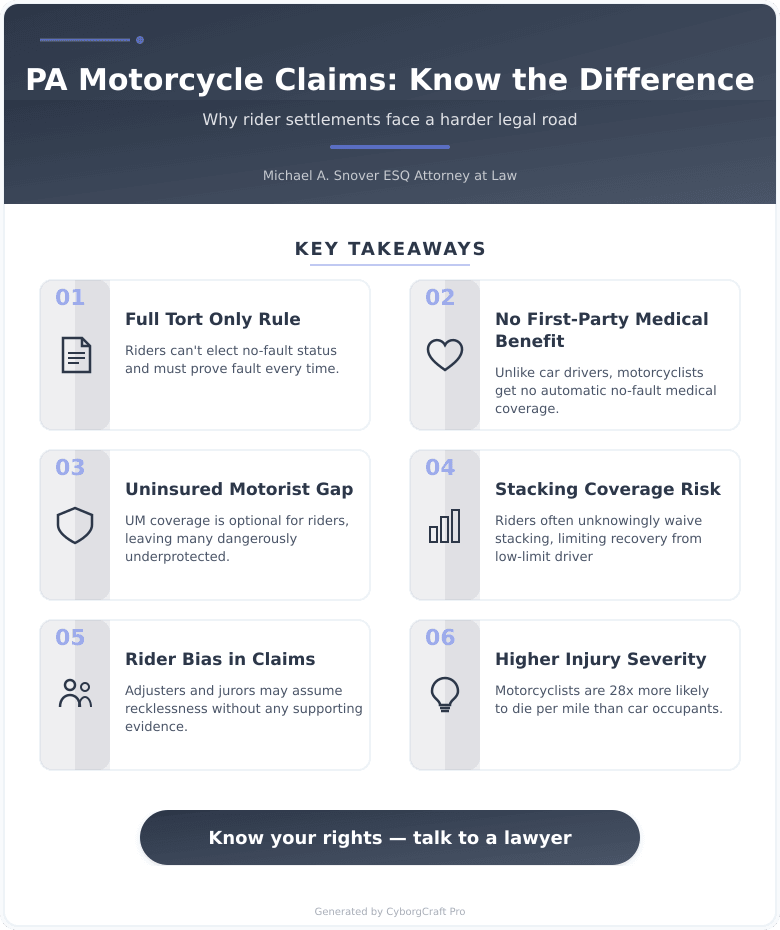
Pennsylvania is a choice no-fault state (under 75 Pa. C.S. § 1705). Car drivers can elect limited tort coverage, which restricts their ability to sue for pain and suffering unless injuries meet a serious injury threshold. Motorcycle riders, by contrast, are excluded from the no-fault option entirely. Riders operate under full tort rules by default, meaning they retain the right to sue for all damages but also carry the burden of proving fault in every case.
That sounds like a benefit. It isn’t always. Because motorcyclists can’t elect no-fault status, they also can’t access the first-party medical benefit protections that no-fault car drivers receive automatically. According to the National Highway Traffic Safety Administration, motorcyclists are about 28 times more likely per mile traveled to die in a crash than passenger car occupants. The severity of injuries combined with reduced insurance protections creates a serious financial gap for injured riders.
One of the most common mistakes we see is riders assuming their car’s no-fault medical benefits will transfer to a motorcycle crash. They don’t. Pennsylvania law treats motorcycle-involved crashes under a separate set of provisions, and that distinction matters from the moment you file a claim.
Insurance Coverage: What You Have, What You Don’t
Motorcycle insurance in Pennsylvania is not structured the same way as auto insurance. Here’s how the two compare side by side:
| Coverage / Issue | Motorcycle Policy | Standard Auto Policy |
|---|---|---|
| First-party medical benefits (PIP) | Not required by Pennsylvania law; usually unavailable | Required minimum $5,000 in medical benefits |
| No-fault / limited tort eligibility | Excluded — riders are full tort by default (75 Pa.C.S. § 1705) | Driver chooses limited tort or full tort at policy purchase |
| UM / UIM stacking | Available — can stack across owned vehicles unless waived in writing | Available — same waiver-in-writing rules apply |
| Recovery for pain & suffering | Full recovery available — no tort threshold for riders | Limited tort drivers must meet a “serious injury” threshold |
| Helmet requirement (PA) | Required for riders under 21, or under 2 years’ experience without a safety course | Seat belts required for all occupants |
| Coverage Type | Car Drivers (PA) | Motorcycle Riders (PA) |
|---|---|---|
| No-Fault Medical Benefits | Available (up to $5,000 minimum) | Not available by statute |
| Tort Election | Limited or full tort | Full tort only |
| Uninsured Motorist Coverage | Required unless waived | Optional but strongly advised |
| Underinsured Motorist | Optional | Optional but often excluded |
| Stacking Coverage | Allowed | Allowed but riders often waive it unknowingly |
The stacking issue deserves extra attention. Stacking allows you to combine uninsured/underinsured motorist coverage across multiple policies. Riders who waive stacking without understanding it can significantly limit their recovery when an at-fault driver has minimal coverage.
Thinking about this for your situation? Let’s talk. Contact us and we’ll walk you through your coverage options with no pressure.
Motorcycle Claims vs. Car Accident Claims: A Direct Comparison
Where motorcycle claims succeed: Full tort access means riders can pursue non-economic damages like pain, suffering, and loss of life enjoyment without clearing a verbal threshold. This often produces higher settlements when liability is clear.
Where motorcycle claims fail: Bias against riders is real and documented. Adjusters and jurors sometimes assume a motorcyclist was riding recklessly even without evidence. Pennsylvania’s contributory fault rules (under the comparative negligence statute, 42 Pa. C.S. § 7102) allow an insurer to reduce your settlement by whatever percentage of fault they assign to you. If they pin 30% of blame on you, your recovery drops by 30%.
Where car accident claims succeed: Car drivers benefit from no-fault medical coverage that kicks in immediately regardless of who caused the crash. Medical bills get addressed faster, which reduces early financial pressure.
Where car accident claims fail: Limited tort elections can bar recovery for pain and suffering unless injuries are serious under Pennsylvania’s definition, which isn’t always met even in significant crashes.
The verdict: Motorcycle riders have more legal access to full damages but face steeper evidentiary challenges and fewer automatic insurance protections. A well-documented claim with strong liability evidence is essential to recovering fair compensation.
Your Motorcycle Accident Action Plan
- Step 1 – Document Everything at the Scene: Photograph road conditions, vehicle positions, your gear, and any visible injuries. This evidence fights back against bias later.
- Step 2 – Seek Immediate Medical Attention: Even if you feel okay, get evaluated. Gaps in medical care are one of the top reasons insurers reduce motorcycle settlement offers.
- Step 3 – Review Your Insurance Policy: Check whether you waived stacking, what your UM/UIM limits are, and whether you have medical payment coverage. Do this before you speak to the other driver’s insurer.
- Step 4 – Preserve Your Gear: Your helmet, jacket, and riding boots are evidence. Don’t discard damaged gear before your claim is resolved.
- Step 5 – Track Every Financial Loss: Keep records of medical bills, missed work, prescription costs, and any transportation expenses. Pennsylvania allows recovery for all of these under full tort rules.
- Step 6 – Be Aware of the Statute of Limitations: Pennsylvania generally requires personal injury claims to be filed within two years of the accident date under 42 Pa. C.S. § 5524. Missing this deadline ends your right to recover.
What Damages Can Pennsylvania Motorcycle Riders Actually Recover?
Under full tort rules, injured riders in Pennsylvania can pursue:
- All past and future medical expenses
- Lost wages and reduced earning capacity
- Pain and suffering
- Emotional distress and loss of enjoyment of life
- Property damage to the motorcycle
- Wrongful death damages if a rider is killed (brought by surviving family members)
Recent data from Pennsylvania crash reports shows that motorcycle accidents account for a disproportionate share of serious injury claims statewide. Riders who carry full UM/UIM coverage and document their losses thoroughly consistently recover more than those who don’t. The Pennsylvania Department of Transportation reported that motorcycle fatalities represented roughly 18% of all traffic deaths in a recent 12-month period despite motorcycles making up a small fraction of registered vehicles.
At Michael A. Snover ESQ Attorney at Law, located in Bethlehem, PA, the focus is on making sure riders throughout the Lehigh Valley and surrounding communities understand these distinctions before their claim gets underway. Riders in Allentown, Easton, Nazareth, Whitehall, Emmaus, and the broader Northampton and Lehigh County areas face the same systemic challenges when filing motorcycle injury claims.
Want to explore what your claim may be worth? Get more information or review our services to see how we approach motorcycle injury cases in Pennsylvania.
Key Takeaways for Pennsylvania Motorcycle Riders in 2026
- No-fault rules don’t apply to you – motorcycle riders operate under full tort by default, which changes how your claim is handled from the start.
- Stacking waivers can limit your recovery – review your policy before you assume you have adequate UM/UIM protection.
- Bias is a real legal obstacle – strong documentation and a clear liability narrative are your best tools against unfair fault assignments.
- The two-year deadline is firm – waiting to file a claim risks losing your right to any recovery under Pennsylvania law.
- Full tort access is an advantage – use it by tracking every loss and getting consistent medical treatment from day one.
Frequently Asked Questions
Does Pennsylvania require motorcycle insurance in 2026?
Yes, Pennsylvania requires minimum liability insurance for all registered motorcycles. Minimum limits are 15/30/5 (bodily injury per person / per accident / property damage) under 75 Pa.C.S. § 1786 — riders should confirm exact current minimums against PennDOT requirements, since motorcycle minimums can differ from standard auto minimums. Most attorneys recommend carrying significantly higher limits given the severity of motorcycle injuries.
Can I still recover damages if I was partially at fault for the motorcycle crash?
Yes, Pennsylvania follows a modified comparative negligence rule that allows recovery as long as you are less than 51% at fault. Your total damages are reduced by your assigned percentage of fault, so fighting back against inflated fault attributions matters significantly.
How long does a motorcycle accident settlement take in Pennsylvania?
Most straightforward motorcycle accident settlements in Pennsylvania resolve within 6-18 months. Cases involving serious injuries, disputed liability, or significant medical treatment typically take longer because you need a clear picture of your full damages before settling.
What is the statute of limitations for a motorcycle accident claim in Pennsylvania?
Pennsylvania gives injured motorcycle riders two years from the date of the accident to file a personal injury lawsuit under 42 Pa. C.S. § 5524. Missing that deadline typically means losing your right to any financial recovery, regardless of how strong your case is.
How do insurance companies evaluate motorcycle injury claims differently?
Insurers often apply a higher scrutiny to motorcycle claims because of the assumed risk factor associated with riding. Adjusters may argue the rider’s speed, lane position, or gear choices contributed to the crash in order to reduce the settlement offer.
Should I accept the first settlement offer after a motorcycle accident?
First offers are almost always lower than what a fully documented claim is worth. Insurers make early offers before the full extent of injuries is clear, which can leave future medical costs uncompensated if you accept too quickly.
Does wearing a helmet affect my Pennsylvania motorcycle settlement?
Pennsylvania requires helmets for riders under 21 or those without two years of riding experience or a safety course certificate. For riders not legally required to wear one, helmet use (or lack of it) can still be raised by the defense to argue comparative negligence in head injury cases.
This content is for general informational purposes only and does not constitute legal advice. Laws change, and individual circumstances vary. Consult a licensed Pennsylvania attorney about your specific situation.