

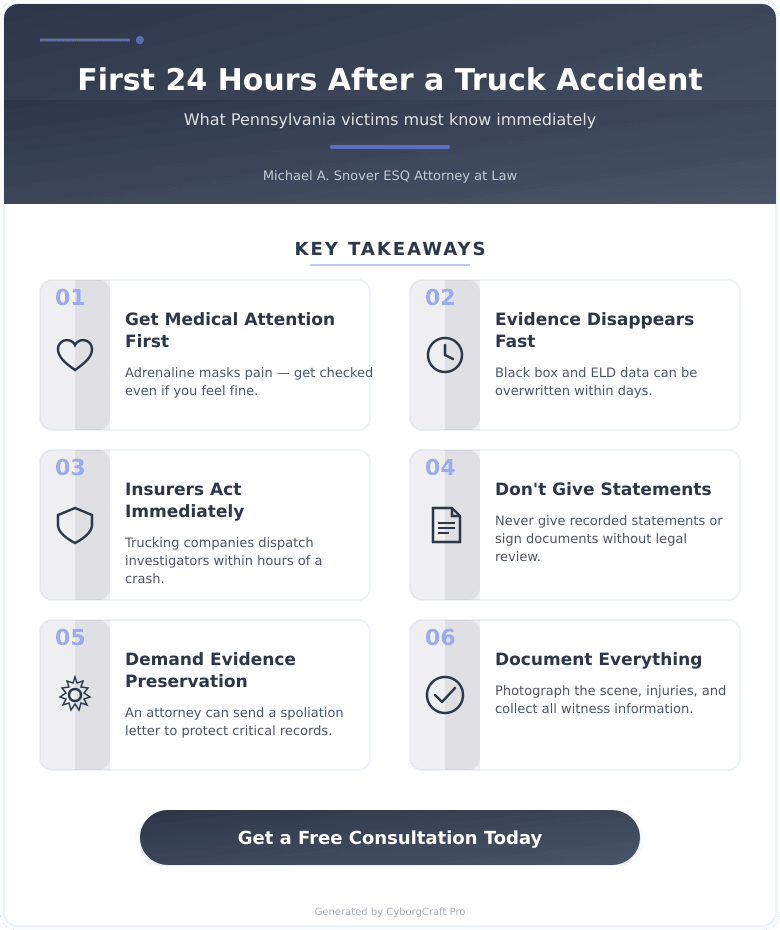
Truck accident cases in Pennsylvania are time-sensitive legal matters where the actions taken within the first 24 hours can determine whether a victim recovers full compensation or loses critical evidence forever. The window right after a crash is short, chaotic, and often misunderstood by the people who need it most.
This guide focuses specifically on Pennsylvania truck accident victims who need to understand what happens legally, physically, and strategically in the hours immediately following a crash.
If you or someone you care about was just involved in a serious collision with a commercial truck, here is what you need to know right now.
Why the First 24 Hours After a Truck Accident Are So Different
A truck accident is not like a standard car crash. Commercial large carriers carry enormous insurance policies and often have claims teams on the road within hours of a serious incident, while smaller fleets typically dispatch insurance adjusters quickly even if not always on-scene. According to the National Highway Traffic Safety Administration, large truck crashes cause thousands of fatalities and tens of thousands of injuries nationally each year. Pennsylvania roads see a significant share of those incidents given the volume of commercial traffic on I-78, I-81, and the PA Turnpike.
The most common mistake we see is victims assuming the insurance company is there to help them. That is rarely the case. Trucking insurers have protocols designed to minimize payouts, and those protocols begin the moment they receive notice of the crash.
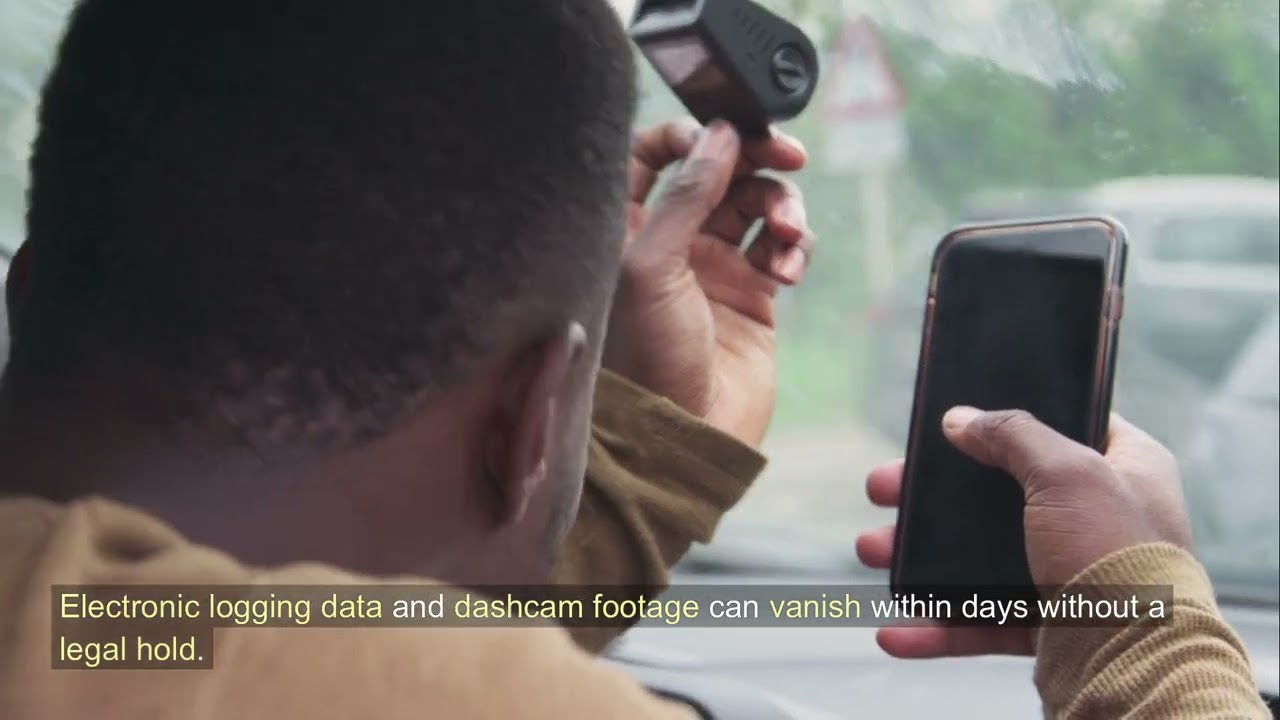
Recent data shows that evidence in truck accidents – including electronic logging device (ELD) data, black box recordings, and onboard camera footage – can be overwritten within days unless preserved — federal rules require carriers to retain Electronic Logging Device (ELD) data for at least 6 months under 49 C.F.R. § 395.8, with other record-retention periods set by 49 C.F.R. Part 379, but practical destruction often happens before any preservation request reaches the carrier if not formally preserved. That is not an accident. It is a legal and logistical reality that favors the trucking company unless you act quickly.
What Actually Happens on the Ground After a Truck Accident in Pennsylvania
Phase 1: Immediate Scene Response (0-2 Hours)
Emergency responders arrive, injuries are assessed, and the scene is documented by Pennsylvania State Police or local law enforcement. A crash report is generated. This report becomes foundational evidence.
Key actions during this phase:
- Get medical attention even if you feel fine – adrenaline masks pain
- Do not apologize or admit fault at the scene
- Photograph everything you can from a safe location
- Collect witness names and contact information
- Note the truck’s carrier name, license plate, and DOT number
Phase 2: Insurance and Corporate Response (2-12 Hours)
This is where the gap between what victims know and what trucking companies do becomes dangerous. Carriers often dispatch accident reconstruction teams and claims investigators almost immediately after a serious crash. Their job is to build a file that protects the company.
Key actions during this phase:
- Do not give recorded statements to any insurance adjuster
- Do not sign any documents without legal review
- Contact an attorney before responding to any outreach from the carrier’s insurer
Phase 3: Evidence Preservation Window (12-24 Hours)
Under federal regulations enforced by the Federal Motor Carrier Safety Administration, trucking companies are required to maintain certain records – but those requirements have limits and timelines. Your attorney can send a spoliation letter (a formal legal demand to preserve evidence) that puts the trucking company on notice that destroying data could result in legal consequences.
Key actions during this phase:
- Retain legal representation so a preservation letter can go out fast
- Document your injuries with photographs before they begin healing
- Keep all medical records, discharge papers, and prescription receipts
Thinking about this for your situation? Let’s talk. Contact us for a free consultation – no pressure, just straight answers about your options.
Handling a Truck Accident Alone vs. Working With an Attorney: What Changes
Where handling it alone succeeds: Minor fender-benders with no injuries, clear liability, and quick settlements from cooperative insurers.
Where handling it alone fails: Serious injuries, disputed liability, multiple parties (driver, carrier, freight broker, shipper), and cases where evidence preservation is critical. You will not know what you do not know, and that ignorance is expensive.
Where working with an attorney succeeds: Preservation letters get sent fast, recorded statement traps are avoided, all liable parties are identified, and damages – including future medical costs and lost wages – are calculated correctly.
Where working with an attorney fails: Occasionally in very low-value cases where the cost of representation outweighs recovery, though most truck accident attorneys handle serious injury cases on contingency.
The verdict: For any truck accident involving injury, legal representation from the start is not just helpful – it is the difference between a fair recovery and a lowball settlement you cannot undo.
| Action | On Your Own | With an Attorney |
|---|---|---|
| Evidence preservation letter | Unlikely within 24 hours | Sent within hours of hire |
| Recorded statement risk | High – often given unknowingly | Avoided entirely |
| All liable parties identified | Rarely | Standard practice |
| Damages calculation | Current bills only | Current and future losses |
See how legal representation changes your position – explore our services and learn what your case may involve.
Your Truck Accident Action Plan for the First 24 Hours
- Step 1 – Seek Medical Care Immediately: Go to an emergency room or urgent care even without obvious symptoms. Documentation starts here and protects your claim.
- Step 2 – Do Not Speak to Insurers: Politely decline any recorded statement requests until you have spoken with a Pennsylvania truck accident attorney.
- Step 3 – Document Everything: Photograph injuries, vehicle damage, road conditions, and any visible skid marks or debris.
- Step 4 – Preserve Your Own Records: Save every receipt, bill, and document related to the crash from this moment forward.
- Step 5 – Contact an Attorney Within Hours, Not Days: The spoliation letter and investigation begin the moment your attorney is retained. Every hour matters.
What You Should Gather Before Your First Legal Consultation
- ☐ Pennsylvania crash report number and responding officer’s name
- ☐ Photographs of the scene, vehicles, and your injuries
- ☐ Names and contact information of all witnesses
- ☐ Truck carrier name, DOT number, and license plate
- ☐ All medical records and bills received so far
- ☐ Insurance cards and policy information for all parties
- ☐ Any written communication from the trucking company or its insurer
Key Takeaways for Pennsylvania Truck Accident Victims in 2026
- Time destroys evidence – electronic data on commercial trucks can disappear within days without a formal preservation demand
- Insurers move fast – trucking carriers often have claims teams on-scene before victims even leave the hospital
- Multiple parties may be liable – not just the driver, but the carrier, shipper, or maintenance contractor
- Pennsylvania’s statute of limitations – personal injury claims in Pennsylvania generally carry a two-year filing deadline, but waiting weakens your case significantly
- Legal representation changes outcomes – the first 24 hours set the trajectory of your entire case
At Michael A. Snover ESQ Attorney at Law, located in Bethlehem, PA, our approach is built on moving fast when clients need it most. The firms that produce real results for truck accident victims are the ones who treat the first day like it matters – because it does.
Frequently Asked Questions
What is the statute of limitations for truck accident cases in Pennsylvania?
Pennsylvania generally allows two years from the date of injury to file a personal injury lawsuit. Waiting even weeks, however, can allow critical evidence to disappear, so contacting an attorney within days of the crash is strongly advisable.
Can I talk to the trucking company’s insurance adjuster after the crash?
You are not legally required to give a recorded statement to the opposing insurer, and doing so can seriously damage your case. Adjusters are trained to ask questions that minimize liability. Always consult an attorney before any recorded communication.
What evidence gets lost if I wait too long after a truck accident?
Electronic logging device data, dashcam footage, GPS tracking, and driver inspection records can all be overwritten or destroyed without a formal preservation demand. This is why the first 24 hours are so critical to your case outcome.
How much does a truck accident attorney in Pennsylvania cost?
Most Pennsylvania truck accident attorneys handle serious injury cases on a contingency fee basis, meaning you pay nothing unless compensation is recovered. Industry contingency fees typically range from 33% to 40% depending on case complexity and whether the matter goes to trial.
Who can be held liable in a Pennsylvania truck accident besides the driver?
Liability in truck accidents often extends beyond the driver to include the trucking carrier, cargo loading companies, freight brokers, and vehicle maintenance contractors. Identifying all liable parties requires a thorough investigation that begins in the first hours after the crash.
Should I go to the emergency room even if I feel okay after a truck accident?
Yes – medical evaluation immediately after a crash is both a health priority and a legal one. Symptoms from spinal injuries, internal trauma, and concussions often appear hours or days later, and a gap in medical treatment can be used against your claim by the insurer.
Your Next Step After a Truck Accident in Pennsylvania
The clock started the moment that crash happened. If you are reading this in the hours or days following an accident, do not wait any longer. Evidence is time-sensitive, insurers are already building their file, and Pennsylvania law has firm deadlines that cannot be extended.
Ready to protect your case? Contact us today for a free, no-obligation consultation. We will walk you through exactly where your case stands and what needs to happen next – with no pressure and no cost to get started. As 2026 brings continued growth in commercial truck traffic across Pennsylvania highways, victims deserve straight answers fast.
This content is for informational purposes only and does not constitute legal advice. Every case is different. Please consult a licensed Pennsylvania attorney about your specific situation.