

Workers’ compensation claims in Pennsylvania are formal legal requests that injured workers file to receive wage replacement and medical benefits after a job-related injury. Filing correctly and on time is the single biggest factor separating successful claims from denied ones.

This guide focuses specifically on Pennsylvania workers injured in the Lehigh Valley area who need to understand the claim process before making a costly error.
Every week, workers across Bethlehem, Allentown, and Easton get hurt on the job and believe the hardest part is behind them once the injury happens. It isn’t. The hardest part is what comes next, and one common mistake quietly destroys more claims than any other factor. Understanding it now could be the difference between a settled claim and a denied one.
The One Mistake That Ends Most Workers’ Comp Claims
Here it is: waiting too long to report the injury to your employer.
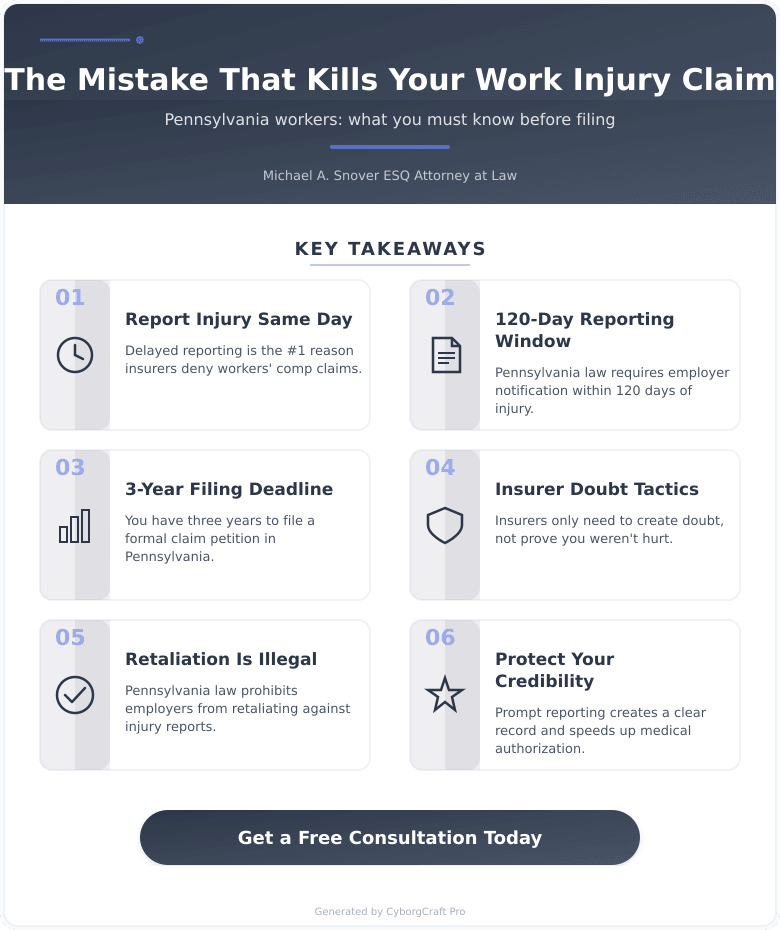
Pennsylvania law requires injured workers to notify their employer within 120 days of the injury. But waiting even a fraction of that time creates serious problems. Insurance adjusters are trained to flag delayed reports as suspicious. Gaps in reporting become gaps in your credibility. The most common pattern we see is a worker who felt the pain, assumed it would go away, and waited a week or two before saying anything. That delay becomes the centerpiece of the employer’s defense.
Report your injury the same day it happens. If symptoms develop gradually, report as soon as you connect the condition to your work. According to the Pennsylvania Department of Labor and Industry, the 120-day reporting window applies, but late reports still allow insurers to challenge your claim aggressively.
Workers’ compensation statute of limitations: In Pennsylvania, injured workers have three years from the date of injury to file a formal claim petition, but the employer must be notified within 120 days or benefits can be denied entirely.
Why Insurance Companies Count on This Mistake
Workers’ comp insurers operate on patterns, and delayed reporting is one of their favorite grounds for denial. Here’s the thing: they don’t need to prove you weren’t hurt. They only need to create enough doubt. A late report does that for them automatically.
The most common defense you’ll see is: “If it were truly a workplace injury, why didn’t you report it immediately?” That question is hard to answer convincingly, even when the injury is completely legitimate.
Disputed claims are widely recognized as taking significantly longer to resolve than undisputed ones, costing injured workers both time and money. Reporting promptly removes one of the insurer’s most reliable tools.
Workers’ Comp Reporting Rule: Report every workplace injury to your supervisor or HR department the same day it occurs, even if you believe it is minor. Minor injuries sometimes develop into serious conditions, and a same-day report protects you in either scenario.
Thinking about how this applies to your situation? Contact us for a free consultation. We’ll walk you through exactly where your claim stands, no pressure involved.
Reporting on Time vs. Waiting: Which Approach Holds Up?
Where reporting immediately succeeds: Preserves your credibility, creates a clear record of injury, prevents insurer delay tactics, and speeds up medical authorization.
Where reporting immediately fails: Workers sometimes fear retaliation (though Pennsylvania law prohibits it), or they genuinely believe the injury is minor and not worth reporting.
Where delaying fails: Creates gaps insurance adjusters exploit, weakens your credibility, and may result in total denial of benefits if you miss the 120-day window.
Where delaying occasionally appears to succeed: Some workers report late and still receive benefits, but only when the injury is severe and undeniable, and even then the process becomes harder and slower.
The verdict: Report immediately, every time. The short-term discomfort of having the conversation with your employer is nothing compared to a denied claim.
| Reporting Timeline | Risk Level | Insurer Challenge Likelihood | Typical Outcome |
|---|---|---|---|
| Same day | Low | Low | Claim proceeds normally |
| Within 1 week | Moderate | Moderate | Possible questions raised |
| 2-4 weeks later | High | High | Likely dispute or delay |
| After 120 days | Severe | Certain | Benefits likely denied |
Your Workers’ Comp Action Plan
- Step 1 – Report immediately: Tell your employer the same day. If a supervisor is unavailable, document that you attempted to report and notify HR in writing.
- Step 2 – Seek medical attention: In Pennsylvania, your employer typically has the right to direct your initial medical care through a panel physician for the first 90 days — but only if the employer has properly posted a list of at least six designated providers in a conspicuous workplace location and notified you in writing of your rights and duties under Section 306(f.1) of the PA Workers’ Compensation Act. If your employer failed to post the list or failed to give you the required written notice, you are not obligated to use a panel physician and may treat with the doctor of your choice from day one. Go to the designated provider, and follow their treatment plan in full.
- Step 3 – Document everything: Keep records of all medical visits, prescriptions, missed work, and communications with your employer or insurer.
- Step 4 – File the claim: Your employer should file a First Report of Injury. Follow up to confirm it was submitted to their insurer.
- Step 5 – Watch for the Notice of Compensation Payable: your employer’s insurer has 21 days to issue either a Notice of Compensation Payable (NCP) accepting the claim, a Notice of Compensation Denial, or a Notice of Temporary Compensation Payable (NTCP). If they issue an NTCP, they have an additional 90 days to convert it to a permanent acceptance or a denial — meaning a “temporary” acceptance is not the final answer, and you should track the 90-day window closely.
- Step 6 – Consult an attorney: If your claim is denied or disputed, or if your employer’s insurer contacts you, speak with an attorney before you respond.
What You Need to Gather Before a Consultation
- ☐ Date, time, and location of the injury
- ☐ Names of any witnesses present
- ☐ Copy of any accident or incident report filed with your employer
- ☐ Medical records and treatment notes from your injury
- ☐ Documentation of missed work and lost wages
- ☐ Any written communication from your employer or their insurer
- ☐ Your employer’s workers’ comp insurance information (if known)
For a full overview of how Michael A. Snover ESQ Attorney at Law approaches cases like yours, visit our homepage or review our services page for more detail.
Common Mistakes That Derail Lehigh Valley Workers’ Comp Claims
- Skipping the panel physician: Pennsylvania employers can require you to see their designated doctors for 90 days. Ignoring this can jeopardize your benefits.
- Posting on social media: Photos or posts that suggest physical activity inconsistent with your injury are used against claimants regularly. Stay offline during your claim.
- Giving a recorded statement without legal advice: Insurers often request recorded statements early in the process. You are not required to provide one, and doing so without preparation can hurt your claim.
- Returning to work before you are medically cleared: Returning early can be used to argue your injuries were never serious.
Key Takeaways for Injured Workers in 2026
- Report the same day – delayed reports are the top reason insurers deny otherwise valid claims
- Pennsylvania’s 120-day rule is a hard deadline – missing it can eliminate your right to benefits entirely
- Follow your employer’s panel physician process – deviating in the first 90 days can cost you coverage
- Document everything in writing – verbal reports and conversations are hard to prove later
- Consult an attorney before speaking with the insurer – early statements often become the insurer’s best evidence against you
Frequently Asked Questions
How long do I have to report a workplace injury in Pennsylvania?
Pennsylvania law requires you to notify your employer within 120 days of the injury. Reporting after this window may result in total denial of benefits, even if the injury is legitimate and work-related.
What happens if my workers’ comp claim is denied?
A denial is not final – you have the right to file a claim petition with the Pennsylvania Workers’ Compensation Appeal Board. This formal process allows you to present evidence before a workers’ compensation judge, and many denied claims are successfully appealed.
Can my employer fire me for filing a workers’ comp claim?
Pennsylvania law prohibits retaliation against employees who file workers’ compensation claims. If you experience adverse employment action after filing, that retaliation may itself be a separate legal matter worth discussing with an attorney.
Do I need a lawyer for a workers’ comp claim?
You are not legally required to have an attorney, but disputed or denied claims are significantly harder to navigate without one. Most workers’ compensation attorneys work on contingency, meaning you pay no upfront fees and the attorney is only paid if you recover benefits.
How long does a Pennsylvania workers’ comp claim take to resolve?
Straightforward accepted claims can begin paying benefits within a few weeks, but disputed claims can take months or longer. The timeline depends heavily on whether the insurer accepts the claim or contests it at a hearing level.
Does workers’ comp cover all of my lost wages?
Pennsylvania workers’ compensation covers approximately two-thirds of your average weekly wage, up to a state maximum that adjusts annually. As of 2026, the maximum weekly compensation rate in Pennsylvania is set by the Department of Labor and Industry each year based on statewide wage data.
What communities near Bethlehem does Michael A. Snover serve?
The firm serves injured workers throughout the Lehigh Valley, including Allentown, Bethlehem, Easton, and surrounding Northampton and Lehigh County communities. Workers from Nazareth, Hellertown, Emmaus, and neighboring areas are also welcome to reach out.
Your Next Step Starts Here
A denied workers’ comp claim does not have to be the end of the road. But the window to act is real, and 2026 cases already in dispute benefit most from early legal input. The workers who fare best are the ones who report promptly, document carefully, and get guidance before the insurer builds its case.
Ready to talk through your situation? Contact us today for a free, no-obligation consultation. At Michael A. Snover ESQ Attorney at Law, located in Bethlehem, PA, we give you straight answers about where your claim stands and what your realistic options are.
Disclaimer: This content is provided for general informational purposes only and does not constitute legal advice. Every case is different. Please consult a licensed Pennsylvania attorney about your specific situation.