
Pennsylvania dog bite liability law imposes strict liability for medical costs only when an unprovoked dog bite occurs — meaning the owner pays medical expenses regardless of the dog’s prior behavior. To recover pain and suffering, lost wages, or other non-economic damages, you must additionally prove the owner was negligent (typically by showing they knew the dog had vicious tendencies). This law gives bite victims stronger legal standing than most people realize.

This guide focuses specifically on Pennsylvania dog bite victims who want to understand their legal rights under state law before speaking with an attorney.
Most people who get bitten by a dog in Pennsylvania assume the owner only owes them something if the dog was “known to be dangerous.” That assumption costs victims money every year. The truth is more complicated and more favorable to you than the insurance company handling the claim will ever volunteer.
How Pennsylvania’s Dog Bite Liability Law Actually Works
Pennsylvania’s dog bite liability framework under state law establishes distinct standards for different types of damages. Here is what that means in plain terms:
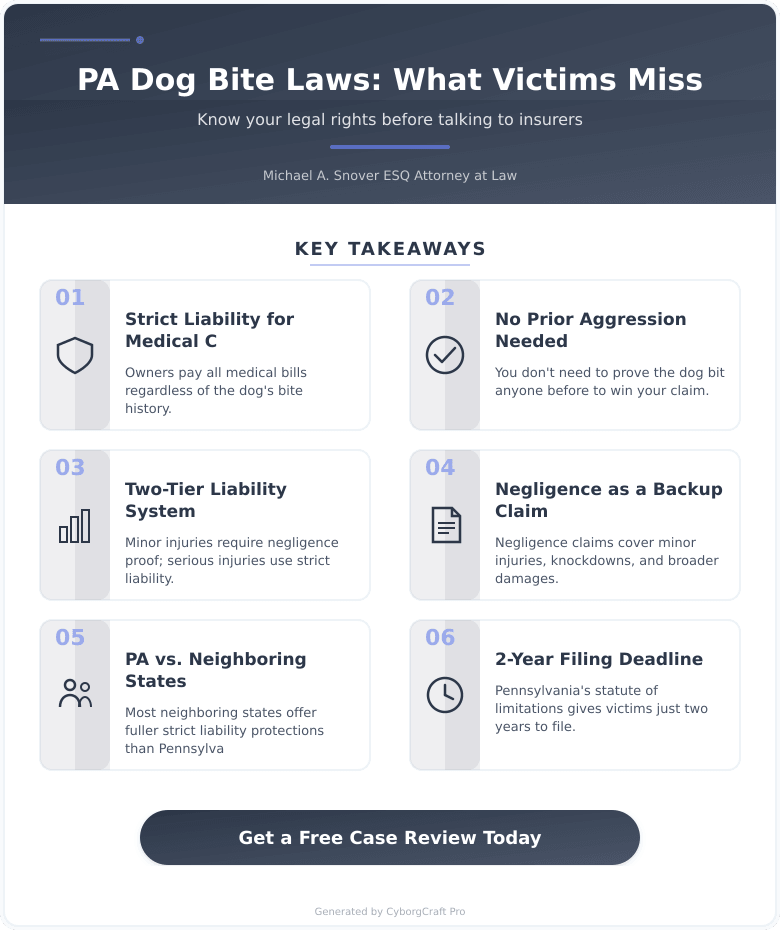
- The owner is strictly liable for all medical costs from an unprovoked bite, regardless of injury severity or prior behavior. Other damages require proving negligence.
- Medical expenses are covered under Pennsylvania’s strict liability rule (3 P.S. § 459-502(b)) without needing to show the owner was at fault or aware of prior dangerous behavior — but this strict liability covers medical costs only. All other damages (pain and suffering, lost wages, future treatment) require proving negligence.
- Victims can also pursue negligence claims alongside or instead of strict liability claims
The practical impact is significant. You do not need to prove the dog bit someone before. You do not need to show the owner was careless. The law places responsibility for medical costs on the owner’s side from the outset.
According to the Centers for Disease Control and Prevention, roughly 4.5 million dog bites occur in the United States each year, with approximately 800,000 requiring medical attention. Pennsylvania consistently ranks among states with higher bite incident rates, partly due to its rural dog ownership patterns and suburban density in counties like Northampton and Lehigh.
Pennsylvania Dog Bite Liability vs. Neighboring States
| State | Liability Standard | One-Bite Rule? | Statute of Limitations | Comparative Fault? |
|---|---|---|---|---|
| Pennsylvania | Strict liability for medical costs only; negligence required for other damages | Partial (minor injuries) | 2 years | Yes |
| New Jersey | Strict liability for all damages | No | 2 years | Yes |
| New York | Mixed (strict for medical costs) | Yes (pain and suffering) | 3 years | Yes |
| Maryland | Strict liability for all damages | No | 3 years | Yes |
| Ohio | Strict liability for all damages | No | 2 years | Yes |
| Delaware | Strict liability for all damages | No | 2 years | Yes |
Pennsylvania’s two-tier approach is actually less victim-friendly than most neighboring states for minor injuries. But for serious injuries, the strict liability standard puts real leverage in a victim’s hands.
Thinking about this for your situation? Let’s talk. Contact us for a free case review and straight answers about what your claim may be worth.
Strict Liability vs. Negligence: Which Approach Works?
Where strict liability succeeds: No need to prove owner knowledge or fault. Faster path to establishing liability for serious injuries. Strong foundation for insurance negotiations.
Where strict liability fails: Does not apply automatically to minor injuries. Does not cover property damage. Cannot be used if the victim was trespassing at the time of the bite.
Where negligence succeeds: Covers minor injuries when you can show owner carelessness. Applies to incidents beyond direct bites (knockdowns, chasing incidents). Can capture broader damages.
Where negligence fails: Requires more evidence and stronger proof. Takes longer to establish in negotiations or court. Owner’s attorney has more room to contest liability.
The verdict: For serious Pennsylvania dog bite injuries, pursue strict liability as the primary theory and layer negligence as a secondary argument. For minor injuries, build a negligence case from the start with documented evidence of the owner’s awareness of the dog’s behavior.
What Insurance Companies Know That Most Victims Do Not
The most common mistake victims make is contacting the dog owner’s homeowner’s insurance directly without understanding how adjusters evaluate these claims. Adjusters are trained to minimize payouts. Here are the tactics they use:
- Asking for recorded statements early to lock in details before you know the full extent of injuries
- Offering fast settlements before you know the full extent of your injuries
- Raising provocation defenses even in cases where no real provocation occurred
- Disputing whether injuries qualify as “serious” under Pennsylvania’s two-tier standard
Homeowner’s insurance covers most dog bite claims nationally, with average payouts around $50,000 based on recent historical data. But that average reflects negotiated or litigated outcomes, not first offers.
Your Pennsylvania Dog Bite Action Plan
- Step 1 – Get medical care immediately: Document every injury, treatment, and cost. Medical records are the foundation of your claim.
- Step 2 – Photograph everything: Take photos of wounds before and after treatment, the location of the attack, and any torn clothing or damaged property.
- Step 3 – Identify the dog and owner: Get the owner’s name, address, and insurance information. Note whether the dog is licensed in Pennsylvania.
- Step 4 – File an animal control report: Report the bite to your local municipality or county. This creates an official record and may trigger investigation of prior incidents.
- Step 5 – Preserve witness information: Get names and contact details from anyone who saw the attack or knows the dog’s history.
- Step 6 – Consult an attorney before speaking to insurance: Pennsylvania’s two-year statute of limitations gives you time to build a stronger claim. Do not rush into a settlement.
What to bring to your consultation:
- ☐ Medical records and bills
- ☐ Photos of injuries and the scene
- ☐ Animal control report number
- ☐ Owner’s name, address, and insurer
- ☐ Witness contact information
- ☐ Documentation of lost wages if applicable
Common Mistakes That Hurt Pennsylvania Dog Bite Claims
Waiting too long: Pennsylvania imposes a two-year statute of limitations on personal injury claims, including dog bites. Missing this deadline eliminates your right to recover anything.
Accepting a fast settlement: Some dog bite injuries worsen over days or weeks. Infections, nerve damage, and scarring often become more apparent after an initial offer is on the table.
Assuming provocation disqualifies you: Pennsylvania law has a narrow definition of provocation. Simply moving toward a dog or being near it does not constitute provocation under the statute.
At Michael A. Snover ESQ Attorney at Law, located in Bethlehem, PA, we see these mistakes regularly from clients who came to us after an insurer’s first offer fell short. The legal nuances in Pennsylvania’s system matter, and they are worth understanding before you settle anything.
Frequently Asked Questions
Does Pennsylvania follow a “one-bite rule” for dog attacks?
Pennsylvania does not use a traditional “one-bite rule.” Strict liability for medical costs applies regardless of injury severity. The dog’s prior behavior matters when proving the negligence element required for non-medical damages — evidence of past aggression helps establish the owner’s knowledge of the dog’s vicious tendencies. For serious injuries, the state’s strict liability law applies regardless of the dog’s prior behavior. This distinction is critical and often misunderstood by victims and even some adjusters.
What damages can a Pennsylvania dog bite victim recover?
Victims can recover medical costs from an unprovoked bite under Pennsylvania’s strict liability rule (3 P.S. § 459-502(b)). To recover lost wages, pain and suffering, or future treatment costs, you must additionally prove the owner was negligent — most commonly by showing they knew the dog had vicious tendencies or failed to take reasonable steps to control it. In cases involving permanent scarring or disfigurement, courts and juries in Pennsylvania historically award higher noneconomic damages. Property damage is generally handled separately.
How long do I have to file a dog bite claim in Pennsylvania?
Pennsylvania’s statute of limitations for personal injury claims, including dog bites, is two years from the date of the injury. Filing after this deadline almost always results in dismissal of your claim, with no path to recovery.
What if the dog bite happened on the owner’s property?
Trespassing generally eliminates your right to strict liability recovery in Pennsylvania, but lawful visitors retain full protections. This includes guests, delivery workers, postal carriers, and anyone else with permission or legal authority to be on the property.
How much does a Pennsylvania dog bite attorney cost?
Most dog bite attorneys in Pennsylvania handle these cases on a contingency fee basis, meaning no fee unless the case resolves in your favor. Contingency percentages vary but typically range from 33% to 40% of the recovery. Always confirm fee arrangements in writing at the outset.
Can I file a claim if the dog knocked me down but did not bite me?
Yes, Pennsylvania’s strict liability statute covers dog bites specifically, but a negligence claim can apply to knockdowns, chasing incidents, or other aggressive behavior that causes injury. The evidence requirements differ, so documenting the incident thoroughly is especially important in these cases.
What This Means for Dog Bite Victims in the Lehigh Valley
Residents across Bethlehem, Allentown, Easton, Nazareth, Hellertown, and Northampton County face these situations more often than regional news coverage suggests. Dog ownership rates in suburban and semi-rural Pennsylvania communities are high, and not every incident gets reported to animal control.
Understanding your rights under Pennsylvania law in 2026 means knowing the difference between what an insurer tells you and what the law actually says. Those two things are rarely the same. For a full overview of how we approach personal injury matters, or to ask specific questions about your situation, reach out directly.
Ready to take the next step? Contact us today for a free consultation. The sooner you understand your options, the stronger your position before any negotiation begins.
Legal Disclaimer: This article is for general informational purposes and does not constitute legal advice. Pennsylvania law is fact-specific. Consult a licensed Pennsylvania attorney to evaluate your individual situation.
Key Takeaways for Pennsylvania Dog Bite Victims in 2026
- Strict liability applies automatically to serious injuries in Pennsylvania, no prior bite history required
- The two-year deadline is firm and missing it eliminates your right to compensation
- Insurance adjusters are not neutral and first offers rarely reflect full claim value
- Provocation has a narrow legal definition and does not include most common interactions
- Documenting everything immediately is the single most important thing you can do after an attack